

Sustainability · 2025
In this section51 topics
- Sustainability Policy2 items
- Sustainability Goals & UN SDGs3 items
- Policy Review3 items
- Business Value Chain1 item
- Stakeholder Analysis2 items
- Environmental Policy & Guidelines3 items
- Environmental Policy Review3 items
- Energy — Plan & Guidelines2 items
- Energy — Electricity Consumption1 item
- Energy — Fuel Consumption1 item
- Energy — Targets2 items
- Energy — Performance & Outcomes2 items
- Water — Plan & Guidelines2 items
- Water — Withdrawal, Discharge & Consumption1 item
- Water — Targets2 items
- Water — Performance & Outcomes2 items
- Waste — Plan & Guidelines2 items
- Waste — Generation, Disposal & Recycling1 item
- Waste — Targets2 items
- Waste — Performance & Outcomes2 items
- GHG — Plan & Guidelines2 items
- GHG — Emissions1 item
- GHG — Emissions Verification2 items
- GHG — Principles & Standards1 item
- GHG — Targets2 items
- GHG Targets — Net Zero1 item
- GHG — Performance & Outcomes2 items
- Environmental Legal Incidents1 item
- Other Environmental Management1 item
- Social Policy & Guidelines3 items
- Social Policy Review3 items
- Social — Principles & Standards Practised1 item
- Human Rights Due Diligence2 items
- Employees — Plan & Guidelines3 items
- Employees — Workforce1 item
- Employees — Remuneration & Provident Fund1 item
- Employees — Training & Development1 item
- Employees — Occupational Health & Safety1 item
- Employees — Labour Relations1 item
- Employees — Employee Representation2 items
- Employees — Targets2 items
- Employees — Performance & Outcomes2 items
- Customers — Plan & Guidelines3 items
- Customers — Satisfaction Results1 item
- Customers — Targets1 item
- Customers — Performance & Outcomes2 items
- Community & Social — Plan & Guidelines3 items
- Community & Social — Targets1 item
- Community & Social — Performance & Outcomes2 items
- Other Social Management1 item
- Law Violation Incidents1 item
Sustainability Policy
Has a Sustainability Policy
Yes
Policy Description
Sustainability Management Policy and Goals
The Company operates businesses in exhibition design and construction, as well as interior fit-out services. It places importance on designing and delivering high-quality work while adhering to the principles of good corporate governance. The Company is committed to conducting its business responsibly toward the environment and society throughout the value chain through operational excellence, transparency, stakeholder participation, and continuous business development, in alignment with international sustainability practices and standards. The Company strives to become an organization dedicated to driving every possibility toward sustainable development in accordance with its vision and mission, while promoting good practices, building trust, and maintaining a balance between business value and value delivered to all stakeholder groups, as well as managing risks to mitigate potential impacts on the Company’s business operations.
The Company has therefore established a corporate sustainability development policy covering both current and future business operations, with the following sustainability issues:
Sustainability Goals & UN SDGs
Has Sustainability Goals
Yes
Goals Description
The Company has established a strategy and pathway toward sustainable development by giving importance to economic, social, and environmental dimensions. The Company’s approach begins with internal personnel as the starting point in order to guide the organization toward achieving its sustainability goals.
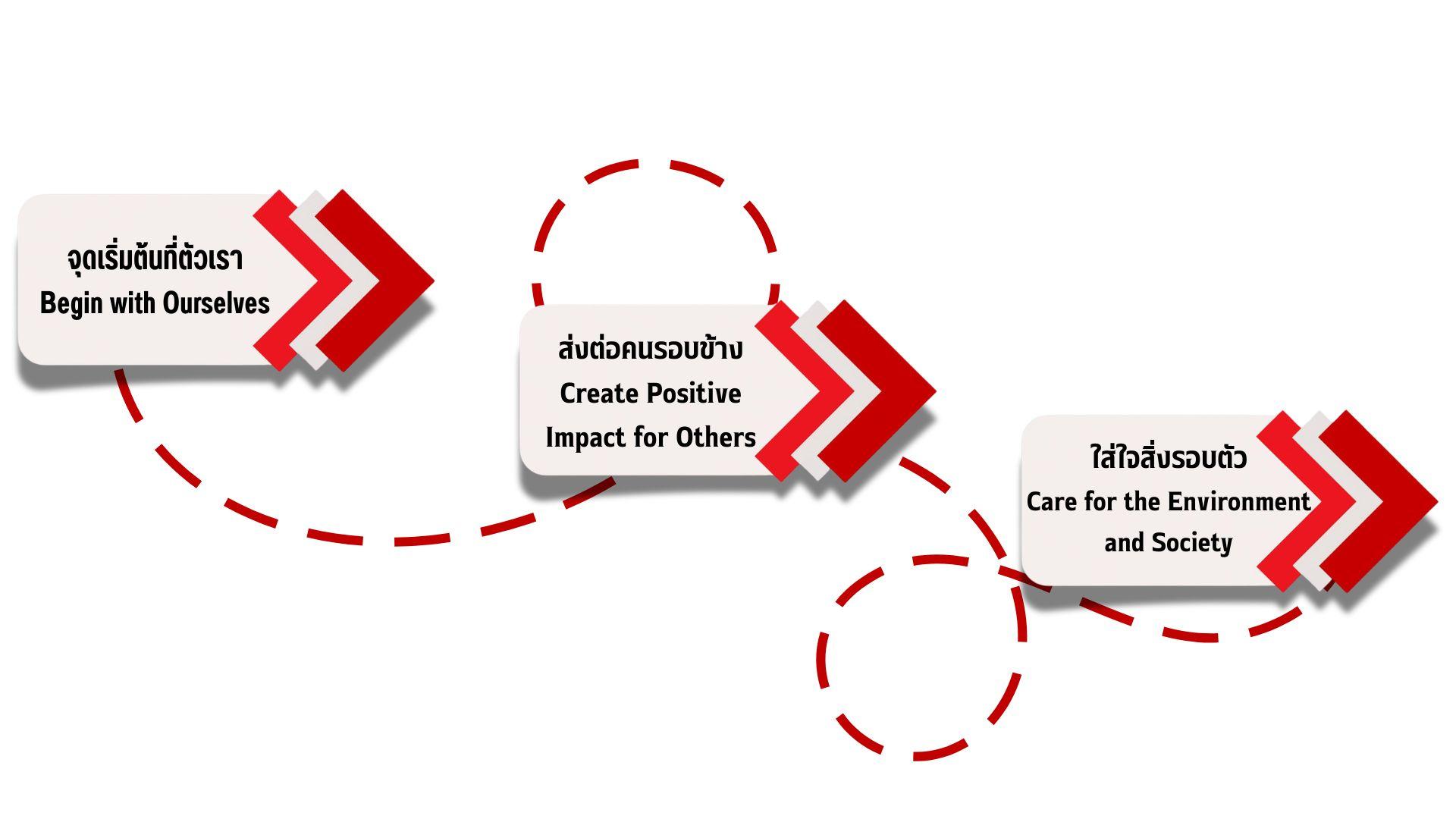
Fair : The starting point of sustainable development begins with fairness and transparency within the organization and between the Company and its employees. This serves as the foundation for effective employees who play an important role in driving the organization in a positive direction, whether in the way the Company treats its employees, business partners, or customers.
Share : Sharing with external stakeholders. Once fairness becomes the foundation and creates motivation, the next step is to extend this sharing to a wider group of stakeholders in order to achieve sound operations and build strong and positive relationships among all parties.
Care : An essential aspect of business operations is caring for one another while protecting the environment alongside business activities. This includes considering the impacts on society and the environment and establishing appropriate approaches for environmental protection and restoration to compensate for any impacts that may occur.
The sustainability strategy can be summarized as follows:
Fair
Operating with fairness and transparency, with a focus on the treatment of employees, business partners, and customers.
Goals
Promote communication, awareness, and understanding among internal personnel regarding the Company’s sustainability goals.
Strengthen employee engagement and enhance employee happiness at work.
Promote the development and potential of employees.
Target stakeholders: Management and employees.
Share
Using fairness as the foundation of management to create motivation and extend value sharing to a broader group of stakeholders.
Goals
Further develop employees within the organization and enhance employee engagement.
Provide knowledge, understanding, and communication to stakeholders across all sectors to raise awareness of sustainable operations.
Foster mutual growth with stakeholders.
Target stakeholders: Employees, customers, business partners, and shareholders.
Care
Conducting business operations with consideration for impacts on society and the environment under environmental standards.
Goals
Operate the business while reducing greenhouse gas emissions.
Manage operations under sustainable development principles.
Create value and development across all dimensions of sustainability.
Target stakeholders: Communities, society, the environment, employees, business partners, and customers.
Materiality Determination
The identification and assessment of K’s material sustainability issues are highly important, as they represent a process to identify issues that impact both internal and external stakeholders comprehensively. These material issues are determined by considering the significant impacts and opportunities related to K’s business operations, as well as the impacts and opportunities of K on its stakeholders. The process consists of the following steps:
UN Sustainable Development Goals
| SDG Goal |
|---|
| Goal 3 Good Health and Well-being |
| Goal 3 Good Health and Well-being |
| Goal 5 Gender Equality |
| Goal 5 Gender Equality |
| Goal 6 Clean Water and Sanitation |
| Goal 6 Clean Water and Sanitation |
| Goal 8 Decent Work and Economic Growth |
| Goal 8 Decent Work and Economic Growth |
| Goal 10 Reduce Inequalities |
| Goal 10 Reduce Inequalities |
| Goal 11 Sustainable Cities and Communities |
| Goal 11 Sustainable Cities and Communities |
| Goal 17 Partnerships for the Goals |
| Goal 17 Partnerships for the Goals |
Policy Review
Policy Reviewed This Year
Yes
Policy Changed This Year
Yes
Review Details
Sustainability Milestones in 2025
Enhancing ESG Management Systems
The company has continuously developed and improved its environmental, social, and governance (ESG) policies, practices, and management processes. It has also integrated sustainability concepts into its business operations and organizational management to align with international sustainable development guidelines.Business Operations Under International Standards and Audits
The company serves international clients, particularly leading global brands, which regularly conduct third-party audits to assess standards in quality, safety, business ethics, and sustainability operations. This consistently drives the company to develop its operational standards to align with international practices.Received a Bronze Medal sustainability rating from EcoVadis
The company received a sustainability assessment from EcoVadis in the December 2025 assessment round and was awarded a Bronze Medal. This award level is granted to organizations whose sustainability performance places them among the top 35% of all companies assessed worldwide.
In 2025, the Company continued to strengthen its sustainability management framework by integrating Environmental, Social, and Governance (ESG) considerations into its corporate policies, operational practices, and management processes. This approach supports the Company’s commitment to aligning its business operations with internationally recognized sustainability principles while responding to the expectations of all stakeholder groups.
During the year, the Company also emphasized aligning its operations with the United Nations Sustainable Development Goals (SDGs) by incorporating sustainability considerations into various aspects of its business practices, including responsible resource management, transparent and ethical business conduct, fair treatment of employees, and responsible practices throughout the value chain.
The Company has experience operating in accordance with international standards relevant to the exhibition and interior fit-out industries. In the past, the Company obtained certifications under ISO 9001 (Quality Management Systems) and ISO 20121 (Event Sustainability Management Systems). Although these certifications are not currently maintained, the Company continues to operate in alignment with the principles of these standards to ensure the quality of its work and the delivery of services that meet client expectations.
Given the Company’s role as a service provider to global clients, particularly leading international brands, the Company is regularly subject to third-party audits appointed by its clients. These audits evaluate operational standards in areas such as quality management, safety practices, business ethics, and sustainability performance within the clients’ supply chains. Such assessments play a significant role in encouraging the Company to continuously enhance its operational standards in accordance with international requirements.
Over the past two to three years, the Company has continuously refined its sustainability policies, practices, and management systems in preparation for sustainability assessments conducted by EcoVadis, a globally recognized provider of sustainability ratings with more than 130,000 companies participating worldwide.
In the December 2025 assessment, the Company achieved a Bronze Medal rating, placing it among the top 35% of companies assessed globally. This achievement reflects the Company’s progress in strengthening its ESG management systems and demonstrates its commitment to conducting business responsibly and in line with international sustainability standards.
The Company will continue to enhance its ESG management practices to strengthen stakeholder confidence and support the Company’s long-term sustainable growth.
Business Value Chain
Value Chain Description
The company has communicated its goals and business operation policies to partners, alliances, and employees within the organization to ensure their understanding and acknowledgement of the objectives. This also aims to gain their continuous and dedicated cooperation, leading to enhanced quality of work and services for both current and future customers. This approach aligns with the organization's business philosophy of being a Value Creator.
Stakeholder Analysis
Introduction
Engagement with K's stakeholders is crucial to the sustainability development plan. Under the operational plan of "Fair" starting from within, "Share" sharing externally, and "Care" for society and the environment, considering the issues that stakeholders prioritize and the level of influence on stakeholders' decisions in such matters.
Stakeholder Analysis
| Stakeholder Type | Stakeholders | Stakeholder Expectations | Response to Expectations | Communication Activities |
|---|---|---|---|---|
| Internal stakeholders | 2921 · Description: Employees | Compensation, Benefits, Career Advancement | A fair and equitable compensation system is provided. Benefits are competitive and suitable. Career growth opportunities are also available. | 2941 · Description: Online Communication · 2942 · Description: Internal Meeting · 2945 · Description: Complaint Reception · 2946 · Description: Employee Engagement Survey · 2947 · Description: Satisfaction Survey · 2949 · Other name: Notice/Bulletin Board · Description: Others · 2949 · Other name: Intranet · Description: Others |
| External stakeholders | 2899 · Description: Suppliers | Fair contracts, conducting business with transparency | Act in accordance with the agreements reached, with fairness. | 2938 · Description: Visit · 2941 · Description: Online Communication · 2945 · Description: Complaint Reception · 2947 · Description: Satisfaction Survey · 2948 · Description: Training / Seminar |
| External stakeholders | 2918 · Description: Contractors | Fair contracts, conducting business with transparency | Compliant with contracts and operates transparently and verifiably. | 2938 · Description: Visit · 2941 · Description: Online Communication · 2945 · Description: Complaint Reception · 2947 · Description: Satisfaction Survey · 2948 · Description: Training / Seminar |
| External stakeholders | 2923 · Description: Customers | Deliver work as required. Deliver quality work. | Delivering work as agreed, exceeding customer expectations and requirements | 2938 · Description: Visit · 2941 · Description: Online Communication · 2945 · Description: Complaint Reception · 2947 · Description: Satisfaction Survey |
| External stakeholders | 2902 · Description: Community | Good environment, community and social development | Create a positive environment in the areas where the company operates and contribute to the development of surrounding communities whenever possible, to foster a better society. | 2938 · Description: Visit · 2940 · Description: Social Event · 2941 · Description: Online Communication · 2943 · Description: External Meeting · 2949 · Other name: Communicate with community leaders · Description: Others · 2949 · Other name: Local employment · Description: Others |
| External stakeholders | 2928 · Description: Society | Good environment, community and social development | Create a positive environment in the areas where the company operates and contribute to the development of surrounding communities whenever possible, to foster a better society. | 2938 · Description: Visit · 2940 · Description: Social Event · 2941 · Description: Online Communication · 2949 · Other name: Communicate with community leaders · Description: Others · 2949 · Other name: Job posting · Description: Others |
| External stakeholders | 2900 · Description: Business partners | Fair Contract, Transparent Business Conduct | Draft a contract that is fair to all parties and conduct business transparently and verifiably. | 2938 · Description: Visit · 2941 · Description: Online Communication · 2945 · Description: Complaint Reception · 2947 · Description: Satisfaction Survey · 2948 · Description: Training / Seminar |
| External stakeholders | 2894 · Description: Creditor | Pay debt on time | Settle debts on time. In the event of significant circumstances that may materially affect the financial status and potentially impact debt repayment, the Company will manage its capital and notify creditors to jointly explore preventive or corrective measures to mitigate any damage. | 2938 · Description: Visit · 2941 · Description: Online Communication |
| External stakeholders | 2904 · Description: Investors or investment institutions · 2913 · Description: Shareholders | Return on Investment, Effective Risk Management, Company Performance and Growth | Dividend payments are made according to the company's policy, provided that there are profits and a sound risk management system in place. | 2938 · Description: Visit · 2939 · Description: Press Release · 2941 · Description: Online Communication · 2944 · Description: Annual General Meeting (AGM) · 2945 · Description: Complaint Reception · 2949 · Other name: Opportunity Day · Description: Others · 2949 · Other name: Annual Report · Description: Others |
| External stakeholders | 2929 · Description: Media | Receive accurate and timely information | Provide accurate and timely information. | 2941 · Description: Online Communication · 2949 · Other name: Interview · Description: Others |
Environmental Policy & Guidelines
Has an Environmental Policy
Yes
Policy Description
Environmental Policy and Practices
The company prioritizes conducting business in conjunction with environmental stewardship, committed to strictly adhering to relevant environmental laws, standards, and regulations. It also establishes appropriate guidelines for managing resources and environmental impacts from operations, covering energy consumption, water resource utilization, waste management, pollution control, and greenhouse gas emission reduction.
The company focuses on efficient resource utilization, reducing environmental impacts from business operations, and appropriately managing waste materials from services and project implementation to prevent adverse effects on society, communities, and the surrounding environment. It also promotes continuous participation of employees and stakeholders in environmental initiatives.
Guidelines
The company aims to reduce environmental impacts from raw material usage and operational processes by conducting environmental impact assessments before introducing new raw materials or processes into operations.
Promote efficient resource utilization by reducing energy consumption, minimizing waste, and controlling pollutant emissions that may arise from the company's activities.
Continuously develop environmental management systems, while promoting environmental knowledge, understanding, and awareness among employees at all levels.
Emphasize communication and building good relationships with surrounding communities, as well as cooperating in activities related to environmental conservation.
Communicate environmental policies, practices, and performance to employees, stakeholders, and relevant parties appropriately.
Environmental Guidelines
| Guideline |
|---|
| Electricity Management |
| Fuel Management |
| Water Management |
| Waste Management |
| Greenhouse Gas and Climate Change Management |
| Air Quality Management |
| Noise Pollution Management |
Environmental Policy Review
Policy Reviewed This Year
Yes
Review Details
In 2025, the Company restructured its Risk, Sustainability, and Corporate Governance Working Committee to make operations more concrete and effectively drive the organization towards standardized and sustainable business practices. This committee serves as a crucial mechanism for setting directions, implementing, monitoring results, and promoting adherence among employees in all departments to guidelines on Risk Management, Sustainability, and Good Corporate Governance.
The Company has regularly held monthly working committee meetings with the executive management, especially during the latter half of the year, to review situations, risks, and external factors that may impact business operations, including economic conditions and significant events. This further reflects the importance of risk management alongside sustainable business operations.
The Company's risk and sustainability governance structure comprises multiple levels to ensure comprehensive oversight and auditing. The Company has a Risk, Sustainability, and Corporate Governance Committee, operating under the supervision of the Board of Directors and the Audit Committee, responsible for setting policies and directing operations. Meanwhile, operational-level working groups drive operations, monitor results, and report progress to relevant executives and committees.
Furthermore, the Company has a multi-mechanism system for auditing and evaluation, including internal audit committees, external auditors and assessors, and assessments from clients, particularly international brands. This helps elevate the Company's operational standards to align with international requirements and practices.
Regarding environmental operations, the Company has initiated discussions with business partners on approaches to resource management and environmental impacts throughout the value chain, from upstream processes to service delivery to clients. This includes assessing and calculating greenhouse gas emissions from the Company's activities, as well as developing guidelines for providing carbon footprint calculation services for client projects and activities, to collectively reduce environmental impacts concretely.
In addition, the Company has reviewed and updated its environmental operational measures to comply with client requirements, especially those of international brands, as well as relevant sustainability assessment standards such as EcoVadis and assessments based on the Thailand Sustainable Event Management Standard (TSEMS) Level 2, to elevate the organization's operations to international standards.
The Company will continue to develop its environmental and sustainability management approaches, focusing on efficient resource utilization, reducing environmental impacts from business operations, and creating shared value with stakeholders, to support the organization's stable and sustainable long-term growth.
Policies & Guidelines Changed
| Change | Other — Please Specify |
|---|---|
| Waste Management | |
| Other | Efficient utilization of relevant resources |
Energy — Plan & Guidelines
Has an Energy Management Plan
Yes
Plan Description
Sustainable Energy Management Policy
The company is committed to utilizing energy efficiently and to its maximum benefit by improving energy performance, reducing waste, and inspecting and maintaining equipment across all activities and processes of the company to conserve energy from normal business operations. This is considered an integral part of business operations, which management at all levels must promote, support, and consider as a shared direct responsibility. Therefore, this energy policy is hereby announced as a guideline for collective action, as follows:
Commit to complying with laws, customer requirements, and various regulations related to effective energy conservation and management, including providing necessary resources and sufficient information to achieve objectives, targets, and maintain the energy management system.
Utilize production technology, production resources, and energy efficiently and cost-effectively, suitable for the nature of operations and internationally accepted best practices, by adopting the 4Rs strategy: Reduce, Reuse, Recycle, and Replacement, which will lead to sustainable energy development.
Provide sufficient necessary resources for human resource development, design, procurement of machinery, production equipment, and other services as appropriate, considering the improvement of energy performance, enhancement of energy conservation efficiency, and energy saving, which is the responsibility of management and employees at all levels.
Communicate, campaign, promote, raise awareness, and support collaboration in sustainable energy development among stakeholders to participate in energy conservation, develop renewable energy, recycle used resources, reduce various pollutions, minimize energy loss, and enhance energy efficiency throughout the product life cycle to achieve Sustainable Development Goals (SDGs).
Define and review objectives, strategies, action plans, and targets for developing an energy management system in accordance with international standards, and prepare the company's energy management report for submission to management and disclosure to stakeholders.
All employees of the company, including contractors and partners, must strictly adhere to the company's energy policy in its implementation and be prepared to disseminate it to the general public.
Energy — Electricity Consumption
Electricity Consumption
| Metric | Current Year | Previous Year | Two Years Ago |
|---|---|---|---|
| Total electricity consumption within the organization (Kilowatt-Hours) | 272,342.41 | 302,867 | 283,274.43 |
| Electricity purchased for consumption from non-renewable energy sources (Kilowatt-Hours) | |||
| Electricity purchased or generated for consumption from renewable energy sources (Kilowatt-Hours) |
Energy — Fuel Consumption
Fuel Consumption
| Metric | Current Year | Previous Year | Two Years Ago |
|---|---|---|---|
| Crude oil (Barrels) | |||
| Coal (Metric tonnes) | |||
| Jet fuel (Litres) | |||
| Diesel (Litres) | 13,941 | 16,360.86 | 14,562.69 |
| Gasoline (Litres) | |||
| Fuel oil (Litres) | |||
| Natural gas (Standard cubic feet) | |||
| LPG (Kilograms) | |||
| Steam (Metric tonnes) |
Energy — Targets
Has Set Targets
Yes
Targets
| Target | Base Year | Base Year Value | Target Year | Target Change (%) | Unit |
|---|---|---|---|---|---|
| Reduction of electricity purchased for consumption | 2,020 | 366,604 | 2,030 | 20 | Kilowatt-hour |
| Reduction of fuel consumption | 2,020 | 18,408 | 2,030 | 20 | Litres |
Energy — Performance & Outcomes
Has Performance Results
Yes
Performance Description
Energy Management
The Company is committed to responsible energy consumption by monitoring and controlling usage to reduce the amount consumed. The energy sources used are as follows:
Electricity used for office buildings, factories, and machinery.
Fuel used for vehicles transporting goods and personnel to/from the office and various projects.
Targets for energy consumption reduction
Electricity consumption, based on the workload from 2020, will be reduced by 20% by 2030.
Fuel consumption for transportation vehicles, based on the workload from 2020, will be reduced by 20% by 2030.
Guidelines and measures for reducing electricity and fuel consumption
Replace old, high-power light bulbs with LED bulbs in both office buildings and factories.
Implement separate circuit switches for electrical equipment and lighting, ensuring they are used only when necessary.
Set the air conditioning temperature at 25 degrees Celsius and establish on/off times for air conditioners in office buildings.
Inspect and control the maintenance of tools, machinery, and electrical equipment according to schedule.
Plan appropriate transportation routes for vehicles to reduce fuel consumption for transport.
Water — Plan & Guidelines
Has a Water Management Plan
Yes
Plan Description
Water Management
The Company is committed to responsible tap water usage. The tap water utilized within the Company is exclusively for domestic and consumption purposes. Furthermore, the Company has promoted efficient and appropriate water usage.
Water — Withdrawal, Discharge & Consumption
Water Withdrawal, Discharge & Consumption
| Metric | Current Year | Previous Year | Two Years Ago |
|---|---|---|---|
| Total water withdrawal (Cubic meters) | 1,788 | 2,657 | 2,377 |
| Total water withdrawal by third-party water (Cubic meters) | 1,788 | 2,657 | 2,377 |
| Total water withdrawal by surface water (Cubic meters) | |||
| Total water withdrawal by groundwater (Cubic meters) | |||
| Total water withdrawal by seawater (Cubic meters) | |||
| Total water withdrawal by produced water (Cubic meters) | |||
| Percentage of wastewater treated before discharge (%) | |||
| Total water discharge (Cubic meters) | |||
| Total water discharge to third-party water (Cubic meters) | |||
| Total water discharge to surface water (Cubic meters) | |||
| Total water discharge to groundwater (Cubic meters) | |||
| Total water discharge to seawater (Cubic meters) | |||
| Total water consumption (Cubic meters) | 1,788 | 2,657 | 2,377 |
| Recycled water (Cubic meters) |
Water — Targets
Has Set Targets
Yes
Targets
| Target | Base Year | Base Year Value | Target Year | Target Change (%) | Unit |
|---|---|---|---|---|---|
| Reduction of water withdrawal | 2,020 | 1,855 | 2,030 | 20 | Cubic meters |
Water — Performance & Outcomes
Has Performance Results
Yes
Performance Description
Goals for reducing tap water consumption
Reduce tap water consumption by 20% by 2030, based on the number of employees from 2020.
Guidelines and measures for reducing tap water consumption
Appoint responsible personnel to oversee and monitor water usage in each office building and factory.
Conduct monthly inspections and repairs of tap water pipe leaks.
Implement zone-based adjustments for turning water valves on and off, and regulate usage to only what is necessary.
Replace sanitary ware with water-saving models.
Waste — Plan & Guidelines
Has a Waste Management Plan
Yes
Plan Description
Internal Waste Management Policy
The Company recognizes the importance of waste management within the Company, including offices, factories, and project sites. All operations must comply with local and relevant laws. The Company has established the following waste management policies and guidelines:
Hazardous Waste refers to waste, disused materials, deteriorated products, or various containers that contain or are contaminated with hazardous substances/materials such as toxic substances, flammable substances, corrosive chemicals, radioactive substances, and pathogenic substances, etc.
General Waste refers to household waste or general waste that cannot be reused or repurposed.
Recyclable Waste refers to waste, discarded materials, or surplus materials that can be reused or repurposed. This includes items donated or sent for processing into raw materials for various production processes. The Company requires employees to sort waste into the following categories: metal, paper, glass, and plastic.
Waste — Generation, Disposal & Recycling
Waste Generation, Disposal & Recycling
| Metric | Current Year | Previous Year | Two Years Ago |
|---|---|---|---|
| Total waste generated (Kilograms) | 3,877 | 4,576 | 4,185 |
| Non-hazardous waste (Kilograms) | 2,337 | 3,336 | 2,855 |
| Non-hazardous waste - Landfilling (Kilograms) | |||
| Non-hazardous waste - Incineration (with energy recovery) (Kilograms) | |||
| Non-hazardous waste - Incineration (without energy recovery) (Kilograms) | |||
| Non-hazardous waste - Other disposal operations (Kilograms) | |||
| Hazardous waste (Kilograms) | 1,540 | 1,240 | 1,330 |
| Hazardous waste - Landfilling (Kilograms) | |||
| Hazardous waste - Incineration (with energy recovery) (Kilograms) | |||
| Hazardous waste - Incineration (without energy recovery) (Kilograms) | |||
| Hazardous waste - Other disposal operations (Kilograms) | |||
| Total reused/recycled waste (Kilograms) | 145,026.4 | 134,404.7 | 106,500 |
| Reused/Recycled non-hazardous waste (Kilograms) | |||
| Reused non-hazardous waste (Kilograms) | |||
| Recycled non-hazardous waste (Kilograms) | |||
| Reused/Recycled hazardous waste (Kilograms) | |||
| Reused hazardous waste (Kilograms) | |||
| Recycled hazardous waste (Kilograms) |
Waste — Targets
Has Set Targets
Yes
Targets
| Waste Type | Disposal Approach | Target | Base Year | Base Year Value | Target Year | Target Change (%) | Unit |
|---|---|---|---|---|---|---|---|
| Hazardous waste | 2763 · Other name: Utilize services from companies registered with the Department of Industrial Works and submit reports. · Description: Other | Reduce waste volume | 2,020 | 1,040 | 2,030 | 15 | Kilograms |
| Non-hazardous waste | 2763 · Other name: Sent for disposal to the Subdistrict Administrative Organization, which is a local government agency. · Description: Other | Reduce waste volume | 2,020 | 1,200 | 2,030 | 15 | Kilograms |
| Non-hazardous waste | 2758 · Description: Reuse · 2759 · Description: Recycle · 2763 · Other name: Forward for recycling for further utilization · Description: Other | Increase waste utilization | 2,020 | 143,000 | 2,030 | 15 | Kilograms |
Waste — Performance & Outcomes
Has Performance Results
Yes
Performance Description
Company Waste Management Guidelines
The company has categorized waste types within the company for segregation as follows:
Hazardous waste is properly disposed of by utilizing services from companies registered with the Department of Industrial Works and submitting reports.
General waste is sent for disposal to the Sub-district Administrative Organization, which is a local government agency.
Recyclable waste is forwarded for recycling for further utilization.
The company requires relevant employees to collect weight data for all types of waste before disposal, to serve as information for setting targets in waste reduction campaigns.
Waste Management Goals
to reduce the current waste volume by 15% by the year 2030.
GHG — Plan & Guidelines
Has a GHG Management Plan
Yes
Plan Description
Greenhouse Gas Reduction Management
Reduction of Carbon Dioxide Emissions
The company is aware of and prioritizes greenhouse gas reduction management, recognizing that the business activities with the highest greenhouse gas emissions are the use of electricity from machinery in production, the use of air conditioners in offices, and the use of fuel from organizational vehicles. Therefore, the company has implemented continuous machinery maintenance measures in accordance with its energy conservation plan and has set the service life of company vehicles to not exceed 5 years by 2027.
GHG — Emissions
GHG Emissions
| Metric | Current Year | Previous Year | Two Years Ago |
|---|---|---|---|
| Total GHG emissions (Metric tonnes of carbon dioxide equivalent) | 571.54 | 226.43 | 209.28 |
| Total greenhouse gas emissions 1 (Metric tonnes of carbon dioxide equivalent) | 9.44 | 44 | 39 |
| Total greenhouse gas emissions 2 (Metric tonnes of carbon dioxide equivalent) | 188.51 | 181 | 169 |
| Total greenhouse gas emissions 3 (Metric tonnes of carbon dioxide equivalent) | 373.59 | 1.43 | 1.28 |
GHG — Emissions Verification
Introduction
The Company regularly reviews and verifies greenhouse gas emission data from various organizational activities annually, in collaboration with the Sustainability Working Group and relevant departments, to ensure the accuracy of the data and its appropriate reflection of the Company's business operations.
In 2025, the Company developed its data collection methods and expanded the scope of greenhouse gas emission calculations to cover more project-related activities, such as the use of materials and equipment in production, including paints, thinners, adhesives, chemicals, and various types of engineering materials, as well as activities related to post-project material management.
This review and improvement of the data collection process enable the Company to assess greenhouse gas emissions more comprehensively and utilize the data to formulate guidelines for reducing environmental impacts from business operations in the next phase.
Emissions Verified by a Third Party
No
GHG — Principles & Standards
Principles & Standards Applied
| Standard | Other — Please Specify |
|---|---|
| 2671 | |
| 2734 | Net Zero Carbon Events (NZCE) Initiative |
GHG — Targets
Introduction
Target for carbon dioxide emission reduction.
Control and benchmark carbon dioxide emissions from operations and organized activities, aiming for a reduction of at least 50% by 2030, using 2024 as the baseline.
Has Set GHG Targets
Yes
GHG Targets — Net Zero
Net Zero Targets
| Emission Scope | Base Year | Base Year Emissions | Near-term Target Year | Near-term Target Change (%) | Long-term Target Year | Long-term Target Change (%) | Target Year | Target Change (%) | Unit |
|---|---|---|---|---|---|---|---|---|---|
| 2716 | 2,020 | 270 | 2,030 | 50 | 2,040 | 100 | 2,030 | 50 | Metric tonnes of carbon dioxide equivalent |
GHG — Performance & Outcomes
Has Performance Results
Yes
Performance Description
Guidelines and measures for reducing carbon dioxide emissions
Provide knowledge and understanding to stakeholders regarding management methods to reduce gas emissions.
Operate the business with the utmost measures to reduce gas emissions.
Possess tools for calculating gas emissions periodically after activities or within the business.
Review the results of activities and business operations to adjust future plans or targets.
Environmental Legal Incidents
Legal Violation Incidents
| Metric | Current Year | Previous Year | Two Years Ago |
|---|---|---|---|
| Number of cases or incidents of legal violations or negative environmental impact (cases) | 0 | 0 | 0 |
Other Environmental Management
Plan Description
Promoting Employee Knowledge in Alignment with the Environmental Policy
The Company has designed and improved operational plans to promote employee knowledge in alignment with the Company’s environmental policy and environmental management practices. In the past, the Company has provided knowledge to employees through various channels such as training sessions, dissemination through the Company’s intranet and website, and public notice boards. The Company also organizes training for business partners to encourage cooperation in complying with the Company’s sustainability policies, including acknowledgement and commitment to follow such policies, as well as assessing the readiness of business partners in sustainability development.
In addition, the Company has established a LINE Official Account for the KSD unit to communicate and provide knowledge to employees across all departments. The objective and role of establishing the K-Sustainable Development (KSD) unit, or the Company’s Sustainability Development Group, is to drive the Company’s operations and activities toward sustainability in response to the Company’s policy of becoming a sustainable organization. The Company places importance on conducting business and operations that do not create adverse impacts on the environment, society, and the economy, under the principles of good governance.
Employees — Plan & Guidelines
Has an Employee Management Plan
Yes
Plan Description
Employment
The Company has an employment policy that respects the rights and freedoms of employees equally without discrimination based on race, nationality, lineage, ethnicity, skin color, religion, social status, gender, age, disability, or political views. Recruitment and employment decisions are made based on job suitability, educational background, experience, capabilities, and qualifications in accordance with the Company’s regulations, work rules, and job descriptions.
Compensation and Welfare
The Company provides fair compensation by considering factors such as education, experience, job position, and responsibilities. Compensation is determined in accordance with the Company’s salary structure and benchmarked against organizations of similar size and industry, taking into account labor market conditions and the Company’s operational circumstances. In addition to legally required benefits, the Company also provides additional welfare benefits such as health and accident insurance for employees who meet the Company’s eligibility criteria. Medical expense support of up to Baht 2,000 per month is provided for newly hired employees who have not yet met the required service period. Additional welfare support includes funeral assistance for the employee’s legally recognized parents, spouse, or children. The Company also provides annual employee uniforms and a shuttle van service for employees from the Company’s former office location at Krungthep Kreetha.
Employee Representation and Welfare Committee
The Company has established a Welfare Committee consisting of at least 5 employee representatives. The committee represents employees in consultations with the employer regarding employee welfare arrangements. The committee members are elected in accordance with the regulations of the Department of Labour Protection and Welfare.
Employee Financial Assistance
The Company also provides additional support to employees through an employee loan program for emergency or necessary situations. The total loan fund is limited to Baht 500,000 per year. Eligibility criteria are defined, including requirements such as being a permanent employee, minimum length of service, loan limits, repayment terms, and the necessity of the loan.
Provident Fund
The Company established a Provident Fund in accordance with the Provident Fund Act B.E. 2530 (including amendments) since 1994. For employees who participate in the fund, the Company contributes between 5–10 percent of the employee’s salary depending on years of service. Employees may choose to contribute at rates of 3, 5, 10, or 15 percent of their salary.
In 2025, a total of 105 employees participated in the Provident Fund, representing 70 percent of the Company’s total workforce
Human Resources Development Policy
The Company aims to continuously develop employees at all levels, from operational staff to executives, in order to strengthen skills, knowledge, and creativity that support outstanding performance and enhance the Company’s competitiveness and business expansion. The strategies are as follows:
1. Targeted Functional Skill Development
The Company provides training programs aligned with the needs of each job function to enhance employees’ knowledge and skills in their respective fields. These programs enable employees to continuously improve their performance and effectively solve work-related challenges with greater expertise. Training topics are also reviewed annually to ensure alignment with the Company’s policies.
2. Capability Development and Work Readiness
The Company promotes a clear culture of capability development and work readiness through on-the-job training (OJT). Employees are encouraged to understand the Company’s history and organizational values from the past to the present, which are often communicated directly by senior executives, including the Chairman. This approach encourages employees to grow sustainably within their career paths. The Company has also established succession planning guidelines for key positions.
3. Talent Retention
The Company has a policy to retain capable employees and support their career growth by encouraging participation in various training programs that enhance organizational capability and service quality. The Company promotes both experienced employees and new-generation talents with innovative ideas to take on leadership roles. Performance evaluation systems have also been improved to ensure fairness in annual promotions and career advancement, in line with the Company’s core values of “Fairness and Sharing.”
4. Succession Planning
The Company prioritizes internal talent development and promotion rather than external recruitment. This approach helps maintain employee morale and loyalty while enabling experienced employees to share their expertise with younger generations to ensure sustainable organizational development.
5. Ethics
Management is committed to conducting business with integrity and good corporate governance, prioritizing ethical values. The Company emphasizes cultivating ethical awareness among employees at all levels, including integrity, ethics, and anti-corruption policies, encouraging employees to contribute positively to society and surrounding communities while maintaining the trust of customers and shareholders.
6. Employee Turnover Rate
In 2025, the employee turnover rate was 8%, calculated from a total workforce of 150 employees.
Occupational Safety, Health, and Working Environment Policy
The Company is committed to ensuring the health and safety of all employees. The Company continuously strives to maintain a safe and healthy working environment while conducting business operations responsibly. Management at all levels is responsible for ensuring compliance with safety regulations and measures while encouraging employee participation in maintaining workplace safety. The policy includes the following:
All employees must receive training and knowledge related to occupational health, safety, and the working environment.
Employees must strictly comply with all safety rules and regulations.
Supervisors at all levels are responsible for monitoring workplace safety, providing guidance, and setting a good example for their subordinates.
Occupational Safety, Health and Working Environment Goals
Zero work accidents at the head office, factory, and project sites.
Zero work-related diseases.
Occupational Safety, Health and Working Environment Implementation Plan
Review risk assessments related to workplace safety.
Provide safety training before employees begin work at offices, factories, and project sites.
Conduct weekly safety talks or safety briefings before work according to project risk levels.
Issue warning notices and penalties for employees or contractors who fail to comply with safety regulations.
Conduct health screenings before entering project sites and periodic health checks based on risk levels.
Communicate disease prevention measures in accordance with government or local authority announcements.
Monitoring and Reporting
The Company has an Occupational Safety, Health and Working Environment unit responsible for monitoring and supervising potential risks. Performance is monitored through monthly safety committee meetings and regular reports from safety officers at each project site regarding occupational health, safety, and the working environment.
Plan Areas
| Plan Area |
|---|
| Fair employee compensation |
| Employee training and development |
| Promoting employee relations and participation |
| Migrant/foreign labor |
| Child labor |
| Occupational health and safety in workplace |
Employees — Workforce
Workforce Data
| Metric | Current Year | Previous Year | Two Years Ago |
|---|---|---|---|
| Total number of employees (Persons) | 152 | 150 | 130 |
| Number of male employees (Persons) | 78 | 68 | 69 |
| Number of female employees (Persons) | 74 | 82 | 61 |
| Total employment of disabled persons (people) | 3 | 3 | 2 |
| Total disabled employees (people) | 3 | 3 | 2 |
| Total male disabled employees (people) | 2 | 2 | 2 |
| Total female disabled employees (people) | 1 | 1 | 0 |
| Total disabled workers who are non-employee (people) | 0 | 0 | 0 |
| Contributions to the fund for promoting and improving the quality of life for disabled persons | 1 | 1 | 1 |
| Total number of male employees in operational level (Persons) | 44 | 53 | 63 |
| Total number of male employees in management level (Persons) | 31 | 11 | 4 |
| Total number of male employees in executive level (Persons) | 3 | 4 | 2 |
| Total number of female employees in operational level (Persons) | 43 | 68 | 57 |
| Total number of female employees in management level (Persons) | 27 | 9 | 1 |
| Total number of female employees in executive level (Persons) | 4 | 5 | 3 |
Employees — Remuneration & Provident Fund
Remuneration & Provident Fund
| Metric | Current Year | Previous Year | Two Years Ago |
|---|---|---|---|
| Total disabled employees (people) | 106,280,979.99 | 88,057,568.52 | 77,904,594.94 |
| Total male employee remuneration (Baht) | |||
| Total female employee remuneration (Baht) | |||
| Number of employees eligible to participate in PVD (persons) | 150 | 150 | 130 |
| Total number of employees joining employee provident fund (Persons) | 105 | 97 | 90 |
| Percentage of total number of employees joining employee provident fund to total number of employees (%) | 70 | 64.67 | 69.23 |
| Number of PVD members / Total eligible employees (%) | 70 | 64.67 | 69.23 |
| Total amount of provident fund contributed by the Company (Baht) | |||
| Total amount of provident fund contributed by employee (baht) |
Employees — Training & Development
Training Data
| Metric | Current Year | Previous Year | Two Years Ago |
|---|---|---|---|
| Average employee training hours (Hours / Person / Year) | 9 | 6.81 | 7.52 |
| Employee development and training expenses (baht) | 328,099.6 | 331,426 | 244,218.45 |
Employees — Occupational Health & Safety
Occupational Health & Safety Data
| Metric | Current Year | Previous Year | Two Years Ago |
|---|---|---|---|
| Total number of lost time injury incidents by employees (Cases) | 3 | 2 | 3 |
Employees — Labour Relations
Labour Relations Data
| Metric | Current Year | Previous Year | Two Years Ago |
|---|---|---|---|
| Total voluntary resignations (Persons) | |||
| Male employees who voluntary resigned (Persons) | |||
| Female employees who voluntary resigned (Persons) | |||
| Percentage of employee turnover leaving the Company voluntarily (%) | 8 | 16.96 | 25.38 |
| Evaluation result of employee engagement | 1 | 1 | 1 |
Employees — Employee Representation
Employees Are Represented Collectively
Yes
Forms of Representation
| Form |
|---|
| Welfare committee |
Employees — Targets
Has Set Employee Targets
Yes
Targets
| Indicator | Target Areas | Base Year | Base Year — Description | Target Year | Target Year — Description |
|---|---|---|---|---|---|
| Number of work accidents | 2988 · Description: Safety and occupational health at work | 2,020 | 7 cases | 2,030 | Zero work-related accidents |
| Average training hours per employee per year (not less than 12 hours per person per year) | 2984 · Description: Employee training and development | 2,025 | Employees receive an average of 9 training hours per person per year. | 2,030 | At least 80% of employees received training, with an average of 18 training hours per person per year. |
| Employee turnover rate (Turnover Rate) less than 10 percent | 2985 · Description: Promoting employee relations and participation | 2,025 | Employee turnover rate of 8% | 2,030 | Maintain employee turnover rate at less than 10 percent. |
Employees — Performance & Outcomes
Has Performance Results
Yes
Performance Description
The Company has joined the Collective Action Coalition against Corruption (CAC) of the Thai private sector, forming a network of "white" partner organizations that adhere to good governance principles in business operations. This promotes transparency, fairness, and accountability, allowing stakeholders unrestricted access to information. All parties benefit mutually, creating an effective oversight mechanism. In 2017, the Company was certified as a member of the Thai Private Sector Collective Action Coalition Against Corruption (CAC) after undergoing a self-assessment process confirming its anti-corruption policies and practices met CAC criteria. In 2024, the Company's certification as a member of the Thai Private Sector Collective Action Against Corruption (CAC) was renewed for another 3 years.
The Company has implemented its anti-corruption policy as follows:
The Company has communicated to its directors, executives, employees, and workers, stipulating that all operational processes must strictly adhere to legal frameworks. In the event of operational errors due to negligence or oversight, penalties from the government shall be accepted without any attempts to evade responsibility.
The Company provides reporting channels for observed policy violations or corrupt practices and implements protection measures for whistleblowers. The Company has disclosed details of its policies and actions to prevent involvement in corruption on its website under the heading "Good Corporate Governance." Full information link: https://investor-th.kingsmen-cmti.com/corporate-governance/
Whistleblowing
The Company has provided channels for stakeholders to report tips and complaints via email and telephone. An Audit Committee, independent from management, reviews these, and the Company Secretary screens the tips and complaints. The Company is strongly committed to using good corporate governance principles to ensure all personnel strictly adhere to measures, preventing whistleblowing incidents within the Company through transparent and fair principles from the outset.
“In the past year, there have been no complaints regarding corruption or violations of the Company's corporate governance policy.”
Respect for Human Rights
The Company has developed human rights knowledge and instilled awareness among its personnel to adhere to human rights principles. This is achieved through various communication channels such as email, the Company website, Line groups, annual reports, and notice boards at the Company's announcement points, serving as additional avenues for information dissemination. Internal training sessions are regularly organized to review policies, and consideration is given to exchanging opinions or suggestions with external organizations and stakeholders involved in the Company's business operations.
“In the past year, there have been no complaints regarding human rights violations in the Company's business operations."
Fair Treatment of Labor
The Company recognizes the importance of human resource development and fair labor practices, which are key factors in enhancing business value and strengthening the Company's competitiveness and sustainable growth in the future. The following policies and guidelines have been established:
Respects employee rights in accordance with human rights principles and complies with labor laws.
Establishes fair employment processes and conditions, including compensation determination and performance evaluation based on a fair performance appraisal process.
Promotes personnel development by organizing training, seminars, and workshops, as well as sending personnel to participate in various relevant academic seminars and training programs to enhance their knowledge, skills, and potential. The Company conducts training through multiple formats, including workshops, virtual classrooms, practical learning, and external training participation. It also instills positive attitudes, virtues, ethics, and teamwork among personnel. In 2025, employees will be sent to various training courses to develop their knowledge and skills, and external speakers will be invited to conduct in-house training.
Provides various employee welfare benefits as required by law, such as social security, and beyond legal requirements, such as health insurance and accident insurance. This also includes various types of financial assistance to employees, such as educational scholarships for children and funeral assistance.
Annual health check-up services are provided to personnel at all levels of the Company, with examination items determined by risk factors based on age, gender, and individual working environment.
Ensures employees work safely and maintain good hygiene in the workplace by implementing accident prevention measures, fostering safety awareness among employees, providing training, promoting good employee hygiene, and consistently maintaining a sanitary and safe workplace.
Provides opportunities for employees to express opinions or report unfair practices or misconduct within the Company, and includes measures to protect employees who report such matters.
The Company employs persons with disabilities as required by law, at a ratio of 1 person with disability for every 100 employees. In 2025, the Company employed 3 persons with disabilities: 2 male and 1 female.
The Company has established a welfare committee comprising at least 5 employee representatives to consult with the employer regarding welfare provisions. for employees. This committee is elected in accordance with the announcement of the Department of Labor Protection and Welfare.
The Company has established a Work From Home policy for Fridays and Saturdays, allowing employees to work remotely according to Company guidelines. This aims to increase work flexibility, reduce travel constraints, and help employees manage their work-life balance effectively.
Due to the nature of the Company's business, which often involves working during festivals or holidays, the Company has designated an extended special holiday period during the New Year festival, averaging approximately 9–11 days. This allows employees to fully rest and spend time with their families, which is considered part of promoting employee quality of life and commitment to the organization.
Furthermore, the Company has adopted the international SEDEX standard from the UK, which is a standard for ethical trade concerning fair employment, welfare, and safety of employees in the workplace. This is implemented within the organization to maintain the Company's standards for fair labor practices and build trust among its employees.
Customers — Plan & Guidelines
Has a Customer Management Plan
Yes
Plan Description
Customers
The Company is responsible to its customers by maintaining the quality and standards of its products and services, as well as by fully and comprehensively responding to customer needs to ensure long-term customer satisfaction. It also provides after-sales service and accurate information about the Company's products and services. Furthermore, it provides channels for customers to report problems or inappropriate services, enabling the Company to quickly prevent and resolve issues related to its products and services. The Company has established clear and tangible fair and responsible practices towards its customers. It treats customers willingly, maintains customer confidentiality, and does not use customer information for its own or others' undue benefit, nor does it discriminate against any specific individual.
Responsibility to Customers
The Company's business vision focuses on providing services with international quality and standards, adhering to sustainable business principles for the utmost satisfaction and benefit of customers, business partners, and shareholders. Therefore, the quality of work delivered to customers is of paramount importance. The Company has policies and practices regarding the communication of information about its products and services, including the preparation of a company profile document to provide information about the Company, its services, and past achievements, enabling employees to present accurate and complete information to customers.
Additionally, this company profile document is updated every 6 months to keep the information current. Channels for communication are also provided for customers who wish to communicate regarding product or service impacts, through the Company's sales staff, website (form submission, phone, or email), Facebook, and the Company's Line Official account, to offer customers diverse communication options and channels that suit their convenience.
For communicating information about the Company's products and services, by directly meeting and discussing with customers to understand their needs. This is for providing quality products and services that meet customer requirements, as well as receiving feedback and complaints (if any), to achieve mutual benefits as follows:
Set fair and reasonable prices for products and services.
Provide accurate and complete information about products and services.
Manage customer relationships both before and after sales to ensure maximum customer satisfaction with products/services.
Customer Satisfaction Assessment
The Company is committed to continuously developing and improving its operational efficiency and services to deliver the best possible service to customers. The Company prioritizes customer satisfaction while also focusing on creating benefits for society. It conducts annual customer and partner satisfaction assessments for those who use its services through various channels, using the results to improve services and further develop the business. The Company has a plan to enhance customer satisfaction by surveying all customers after project completion and analyzing, developing, and improving based on the satisfaction assessment results to meet customer satisfaction to the greatest extent possible.
Furthermore, the Company provides various channels for receiving feedback, suggestions, and complaints from customers and partners to ensure clarity, speed, and efficiency. A responsible department is assigned to coordinate problem resolution and track progress until fairness and satisfaction are achieved for all parties.
Plan Areas
| Plan Area |
|---|
| Responsible production and services for customers |
| Development of customer satisfaction and customer relationship |
| Protection of customer personal information |
Customers — Satisfaction Results
Customer Satisfaction Results
| Metric | Current Year | Previous Year | Two Years Ago |
|---|---|---|---|
| Evaluation results of customer satisfaction | 1 | 1 | 1 |
Customers — Targets
Has Set Customer Targets
No
Customers — Performance & Outcomes
Has Performance Results
Yes
Performance Description
The Company is committed to operating responsibly in both production and service delivery. We prioritize transparent and clear communication regarding the impact of our products and services on customers and consumers, as well as strict protection of customer personal data. This is to build confidence and trust in using our services.
We continuously assess customer satisfaction through surveys and feedback collection to improve and develop products and services in line with customer needs. Furthermore, we prioritize prompt and efficient communication and response to customer inquiries to ensure customers receive the best possible experience from our products and services.
Driven by our commitment to delivering the highest quality services, the Company has earned the trust of regular customers who continuously utilize our services, as well as premium brand clients who recommend us through word-of-mouth. This has resulted in us becoming a top choice in the industry.
Community & Social — Plan & Guidelines
Has a Community & Social Plan
Yes
Plan Description
Community and Society
Promote participatory community development and instill a strong sense of social responsibility in business operations to create shared value and enhance community quality through various social projects and activities. Examples include donating used and no longer needed furniture, equipment, or items to nearby and remote communities such as temples, schools, or local administrative organizations for public benefit, and distributing influenza vaccines to local authorities for inoculation of residents in nearby areas.
Promote participation to develop communities and society related to the business.
1. Develop partners and associates to operate in accordance with occupational safety standards.
2. Distribute used items to nearby or remote communities for public benefit.
3. Communicate various activities organized by the company to nearby companies, including inviting them to participate in activities such as fire drills, fire escapes, or basic life-saving first aid.
4. Support and promote national skill standards in the MICE electrician field to elevate skill standards for partner groups.
5. Organize various levels of safety officer training for employees and partner groups working with the company.
6. Support the purchase of local community products to generate income.
Activities for Social and Environmental Benefit
The company cares for and prioritizes the safety of communities, society, the environment, and the quality of life of individuals involved in its operations. It promotes environmental and social awareness and responsibility among its employees, and ensures strict compliance with all relevant laws and regulations. Furthermore, the company actively participates in various activities that create and preserve the environment and society, as well as promote local culture in the areas where it operates.
Furthermore, the company recognizes the importance of strengthening the local economy to foster good relationships with communities and to expand business partnerships by sourcing quality local products that meet customer needs. This enhances the company's business competitiveness, builds a positive image, and instills confidence among all stakeholders.
CSR Activities 2568
CSR Activities Supporting Education at Wat Ban Rai School, Phetchaburi Province The Company, in collaboration with its clients and business partners, organized a social activity at Wat Ban Rai School in Phetchaburi Province. The objective was to support education and promote youth development in the community by donating educational equipment and useful items to the school, such as tables, chairs, bookshelves, cabinets, and furniture manufactured by the company, as well as paint and sports equipment according to the school's needs. Snacks and refreshments were also provided to students on June 26, 2568, during the employees' annual recreational trip to Hua Hin District, Prachuap Khiri Khan Province. Company employees collectively participated in volunteer activities, fostering an atmosphere of sharing that created a lasting impression and warmth for both givers and receivers.
Volunteer Project for Good Deeds for Students at Wat Saphan School by CIMB Thai Bank Public Company Limited and Thai TV Color Channel 3 and Kingsmen C.M.T.I. Public Company Limited, with employees and volunteer performers, participated in activities in an atmosphere of shared happiness with the students at the school. The activities focused on supporting education and sports, including the library, computers for learning, a developmental room for young children, English language teaching, school painting, and sports field improvements. In this regard, The company supported tables, chairs, and bookshelves. to improve the atmosphere library for the school On 29 November 2568 Total value 200,000 Baht
Sustainable Business Operations Concept
In accordance with the company's policy for sustainable operations and business practices, the management team and employees have been briefed on the guidelines to achieve the company's mission of creating value through sustainable service quality, thereby maximizing benefits for customers, partners, the organization, employees, and shareholders.
Operating sustainably within the company is not merely a trend, but a long-term commitment of the management team. It begins with fostering employee awareness and care for the environment, reducing unnecessary energy consumption, minimizing household waste or waste from work materials, and decreasing fuel consumption in employees' daily routines or work processes.
In the manufacturing process within the factory, occupational health and safety are controlled, with increased strictness in safety measures to prevent potential accidents. Resource consumption in production is reduced by controlling waste or unnecessary expenditure of materials and various components, and by utilizing resources efficiently. Usable leftover parts from production will be recycled and repurposed into items for public charitable donations.
When working off-site, the project team responsible will emphasize safety every time work commences each day for technicians, workers, and contractors involved, to ensure awareness of safety, prevent unnecessary energy loss, and reduce the use of materials and resources to only what is essential. The goal is to deliver quality work to service recipients and customers on time, while minimizing environmental impact throughout the project duration.
With the company's commitment to creating long-term value for customers for sustainable business, the company has communicated its sustainable operational policy to customers by providing additional information on environmentally friendly product offerings, from design and installation processes to the proper segregation and disposal of waste materials from demolition to minimize environmental impact.
Regarding contractors or partner groups, the company has communicated its policies and business ethics to ensure they are aware of and adhere to them consistently. This includes participating in campaigns for waste segregation, reducing material waste, and efficient fuel consumption at the premises of those contractors or partner groups.
The company aims to provide services to customers at a reasonable profit margin, without focusing on maximizing profits. Instead, it effectively manages direct costs, administrative costs, and internal service costs to achieve lower expenses, thereby ensuring good organizational performance and fostering long-term customer satisfaction with the company's services.
Plan Areas
| Plan Area |
|---|
| Employment and professional skill development |
| Forests and natural resources |
| Occupational health, safety, health, and quality of life |
Community & Social — Targets
Has Set Community & Social Targets
No
Community & Social — Performance & Outcomes
Has Performance Results
Yes
Performance Description
Promote participation to develop communities and society related to the business.
Develop partner groups and associates to operate in accordance with occupational safety standards.
Distribute used workpieces to nearby or distant communities for further public benefit.
Communicate various activities organized by the company to nearby companies, including inviting them to participate in activities such as fire drills, fire escape training, or basic life-saving first aid.
Support and promote the National Skill Standard for MICE Electricians to elevate skill standards for partner groups.
Organize various levels of safety officer training for employees and partner groups working with the company.
Other Social Management
Plan & Outcomes — Description
Procurement Policy
The Company has established procurement policies and practices for sourcing raw materials and products of appropriate quality for use in delivering products and services to customers. All suppliers are treated equally under transparent, fair, and non-discriminatory procurement practices. The Company also sets guidelines for supplier selection, including selecting suppliers with the capability to conduct business sustainably, suppliers whose products meet quality standards, suppliers that can deliver goods and services on schedule, and suppliers that comply with labor laws and human rights requirements. In addition, the Company has established processes for selecting contractors and suppliers by allowing fair competition based on equal access to information. Supplier selection is conducted in accordance with the Company’s supplier evaluation and selection criteria. The Company also prepares appropriate and fair contractual agreements for all parties and implements monitoring systems to ensure compliance with contractual conditions and to prevent corruption and misconduct throughout the procurement process. The Company purchases goods from suppliers and engages contractors in accordance with the Company’s procurement conditions and strictly complies with contractual obligations toward suppliers. Supplier information is properly maintained and will not be used for any improper purposes.
Partnership Development
The Company regularly invites service providers and contractors who have long-term working relationships with the Company to participate in discussions and exchange information. These partners support both of the Company’s core businesses: interior decoration and exhibitions and marketing events. The discussions and information exchanges are beneficial to both parties and help improve operational performance. The Company emphasizes its operational standards and policy requirements to material suppliers and partners to ensure strict compliance. The Company also conducts visits to suppliers’ stores and contractors’ factories to strengthen relationships with partners and relevant stakeholders. The Company believes that maintaining strong relationships with partners and suppliers will enhance long-term business value and sustainable collaboration.
Supplier Selection
The Company applies strict criteria in selecting contractors and suppliers to ensure that they meet the requirements of the Company’s business units. Selection is based on various factors such as product and service quality, delivery reliability, credibility, financial stability, pricing, service attitude, and other relevant considerations.
Suppliers are evaluated for each project by the service users to assess their performance and identify areas for improvement. Overall supplier performance is reviewed every six months, and feedback is communicated to suppliers. The Company also encourages suppliers to maintain and continuously improve their operational standards in order to grow together with the Company.
Suppliers are expected to understand the Company’s business practices and share a commitment to long-term collaboration. Negotiations regarding quantity, pricing, and conditions are conducted to achieve mutually beneficial agreements. The Company also promotes participation in initiatives such as anti-corruption programs.
Workforce and Service Skill Development
The Company places importance on continuously developing the skills and capabilities of its workforce and skilled technicians in order to enhance service standards and operational quality. Employees meet the qualifications required under the regulations of the Skill Development Promotion Committee concerning licensing procedures, suspension, and revocation of licenses for conducting skill standard testing. These qualifications cover fields such as electrical engineering, electronics, computer systems, and electrical work for the Meetings, Incentives, Conferences and Exhibitions (MICE) industry at Level 1.
The Company also organizes training programs and seminars for skilled workers on a continuous basis with support from both internal and external experts. These programs cover technical skills, professional working practices, occupational safety training, as well as basic knowledge on sustainability and risk awareness. This ensures that employees can perform their duties effectively and in accordance with the Company’s operational standards.
In addition, the Company plans to organize internal skill competitions in the future to evaluate training outcomes, encourage skill development, and motivate employees to continuously improve their professional capabilities.
Environmentally Friendly Materials
When designing exhibition booths or decorative elements for events and exhibitions, the Company increasingly specifies construction materials and raw materials for suppliers. These materials must be of good quality, reasonably priced, delivered on schedule, and environmentally friendly, such as recycled or upcycled materials. Examples of materials used in exhibition projects in 2025 include:
Particleboard
An engineered wood product made from wood particles or sawdust compressed under high pressure.
Oriented Strand Board (OSB)
A board made by compressing small wood strands with heat and pressure. The cross-oriented structure of the strands provides strong durability and flexibility.
Carbon Neutral PET
An innovation developed by IVL, representing a carbon-neutral PET resin solution that can be produced in various forms including plastic flakes, resin pellets, short fibers, and long fibers. The production process is designed to be sustainable throughout the supply chain and helps companies achieve sustainability targets by reducing indirect greenhouse gas emissions (Scope 3).
LED Lighting (IninLight)
Energy-efficient LED lighting that does not contain mercury and does not emit harmful UV radiation, making it environmentally friendly and safe for health.
Environmental Management Approach
The Company emphasizes environmentally friendly design and considers the overall environmental context of each project. Materials used in construction are carefully selected, and proper dismantling methods are applied after project completion to minimize environmental impact. The Company applies the sustainability concept Reduce – Create – Balance, aiming to reduce resource use, create new opportunities, and generate positive impacts on society.
Examples include:
Paperless
Reducing paper usage in activities by utilizing digital technologies for communication and promotion.
Multi-Use Displays
Designing materials for multiple uses, such as promotional cups or signboards that can be repurposed as reusable bags after events.
Eco-Friendly Lighting
Using lighting design and reflective materials to enhance brightness within booths while using energy-efficient lighting systems.
Upcycling Materials
Displaying and using 3R materials and furniture within booths to inspire visitors to reduce waste and create value from reused materials.
Waste Management
Reducing waste throughout the exhibition lifecycle—from installation, operation, to dismantling—through proper waste management processes. Materials are sorted and reused or donated for social benefits after the event.
The Company has developed the K-Supplier Code of Conduct to communicate its expectations and commitment to suppliers, contractors, and service providers regarding transparent, ethical, and lawful business operations under good corporate governance principles. The Code promotes awareness of responsibilities toward all stakeholders and encourages social responsibility and sustainable business practices. The main topics include:
Business Ethics
Labor & Human Rights
Occupational Safety & Health
Environment
Sustainable Development Campaign
The Company communicates its sustainability policy to suppliers, contractors, and service providers to ensure that they understand the Company’s commitment to conducting business under good corporate governance and international sustainability principles. The Company is committed to conducting business activities while maintaining balance and minimizing impacts on the economy, society, and the environment. The Company also strives to be a Good Corporate Citizen in promoting sustainable business practices. In 2023, more than 80 partners responded positively and agreed to support this initiative. In 2025, the Company further strengthened sustainability criteria in supplier evaluation and conducted discussions with more than 70 partners to align sustainability policies across environmental, social, and governance dimensions, aiming to promote sustainable business practices and create shared value together.
Law Violation Incidents
Law Violation Incidents
| Metric | Current Year | Previous Year | Two Years Ago |
|---|---|---|---|
| The total number of cases or incidents of significant violations of laws or regulations regarding social and human rights (Cases) | 0 | 0 | 0 |
| The total number of cases or incidents that cause significant labor disputes (Cases) | 0 | 0 | 0 |
| The total number of cases or complaints related to consumer rights violations (Cases) | 0 | 0 | 0 |
| The total number of cases or complaints related to partner rights violations (Cases) | 0 | 0 | 0 |
| The total number of cases or incidents that cause disputes with the community/society (Cases) | 0 | 0 | 0 |
| The total number of cases or incidents related to cyber security or customer data breaches (Cases) | 0 | 0 | 0 |
| The total number of cases or incidents related to safety and occupational health at work (Cases) | 0 | 0 | 0 |